
.png)
Executive Summary
What do Americans think 2026 has in store? In December 2025, Verasight asked 2,000 U.S. adults to share their predictions, and the results show a nation wrestling with big-picture worries while holding onto personal hope. This report dives into the attitudes of adults on political and economic questions, revealing how Americans feel about everything from the midterm elections to inflation, political violence, and global conflicts.
Click here to access the full toplines and crosstabs for this survey.
The 2026 Midterms and 2028 Presidential Race
Even though 2028 seems far off, we couldn’t resist asking people who they’d want to see on each party’s presidential ticket. In past election cycles, the most-cited name has gone on to be the nominee.
Democrats named familiar faces like Gavin Newsom, Kamala Harris, AOC, Pete Buttigieg, Bernie Sanders, Michelle Obama, and Josh Shapiro. Republicans mentioned J.D. Vance, Donald Trump, Marco Rubio, Ron DeSantis, Mike Pence, Nikki Haley, and even Liz Cheney.
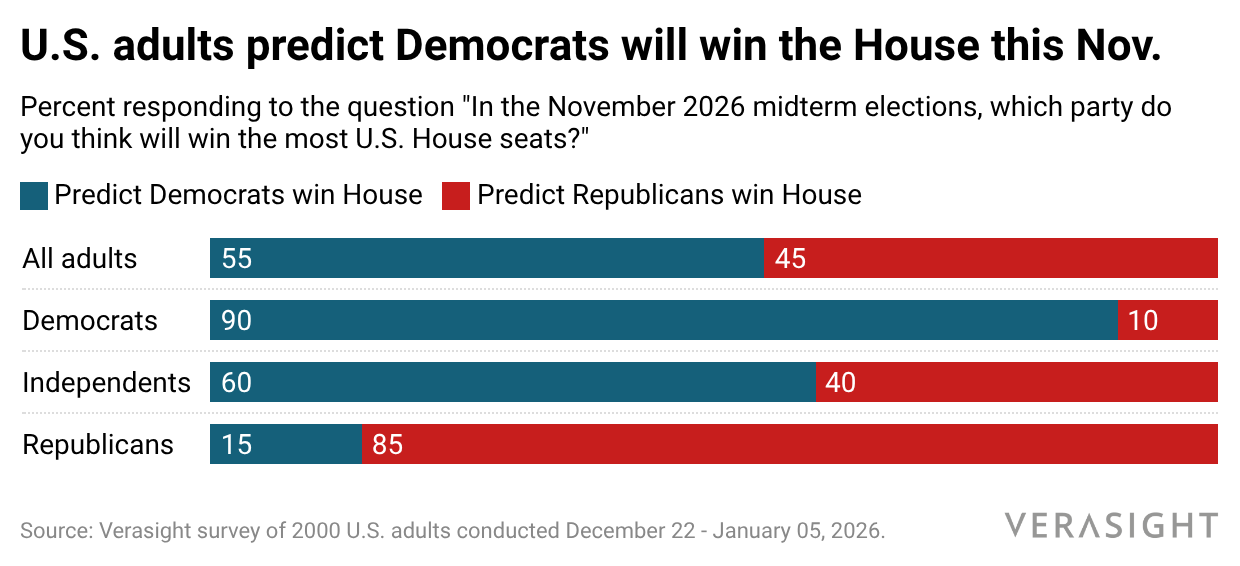
But what about the more immediate future? When we asked about the November 2026 midterms, 55% predicted Democrats would take the most House seats, while 45% bet on Republicans. This Democratic edge showed up across all age groups, but young people were the most bullish on the party. 63% of 18-29 year olds think the Democrats will beat the GOP for the House this November. Independents leaned the same way, breaking 60-40 for Democrats (in terms of who they think will win).
The education divide was interesting too. College grads were a bit more likely to predict Democratic wins than folks without degrees. And women were more optimistic about Democratic chances than men. This generally matches how those groups vote overall, indicating respondents may be wish-casting for their team to win.
Not surprisingly, party loyalty strongly shaped these predictions. Democrats overwhelmingly expected their own side to win (90% to 10%), while Republicans expect their party will hold the House (85% to 15%).
Economics and Personal Finances
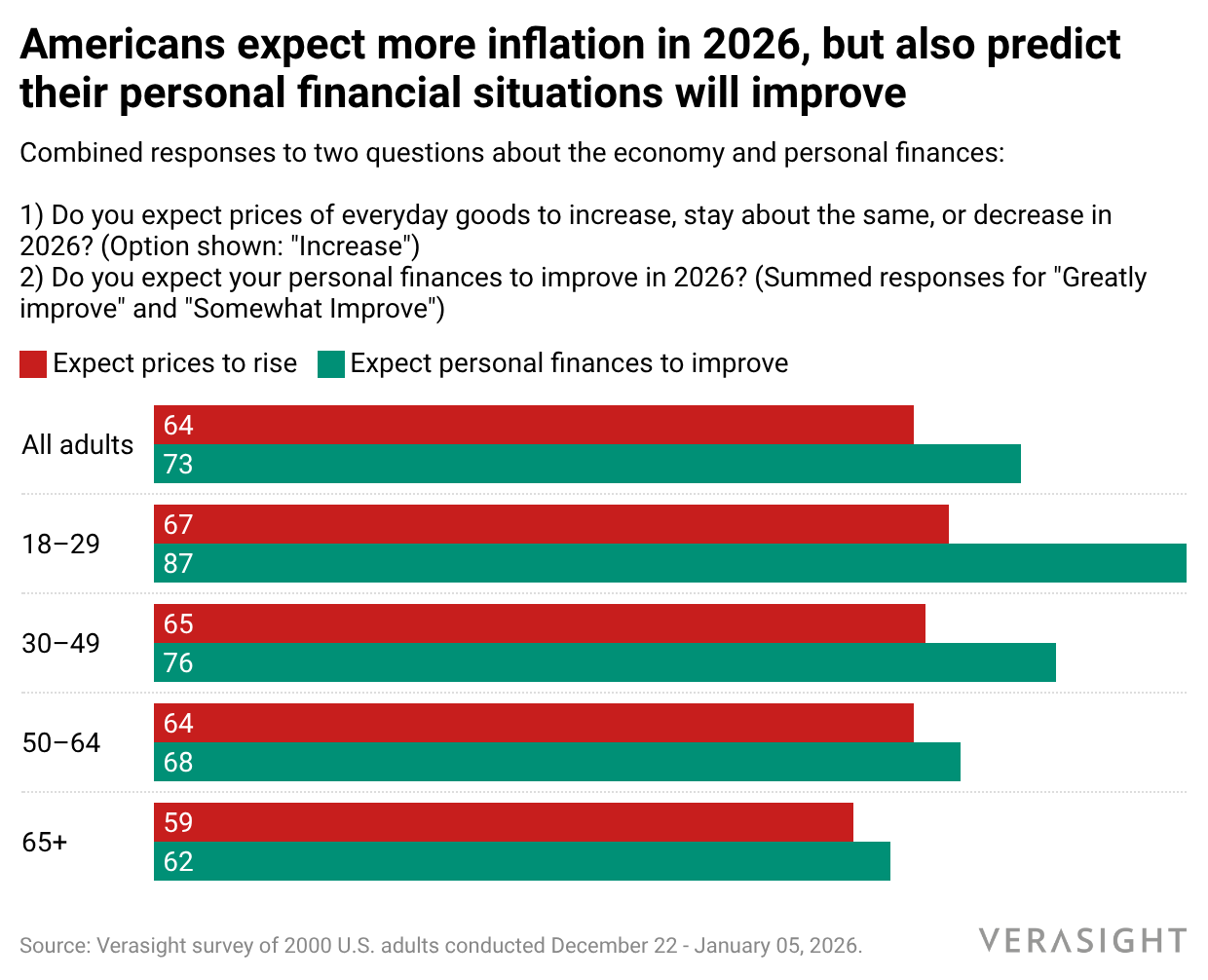
When it comes to the economic big-picture, Americans are pretty nervous about 2026. A solid 64% expect prices of everyday goods to keep climbing, with only 12% thinking they’ll drop and 21% expecting things to stay flat. Surprisingly, young people aged 18-29 were actually the most pessimistic about inflation; 67% expect price hikes. Americans ages 30-49 weren’t far behind at 65%, while older Americans showed slightly less doom and gloom at 64% and 59% for the 50-64 and 65+ crowds respectively.
The confidence gap is real too. More than half of Americans (56%) aren’t feeling great about their income or savings keeping pace with rising prices. That includes 26% who flat-out said they’re not confident at all, and 30% who said they are “not very” confident. The 30-49 age group seems to be feeling the squeeze the hardest, with 32% expressing zero confidence. And money matters here: among people earning under $50,000 per year, only 10% felt “very confident” they could keep up with prices, compared to 20% of those making more than $150,000. At the pessimistic end of the scale, 34% of lower-income Americans said they’re “not confident at all” versus just 14-20% of upper-middle earners.
But here’s the twist: when you ask people about their own personal finances, the mood shifts. A whopping 73% expect things to improve in 2026; 18% anticipate big gains, and 55% expect modest improvement. Young people are especially sunny, with 87% of 18-29-year-olds expecting their finances to get better. That optimism fades a bit with age: 76% for 30-49 year olds, 68% for 50-64, and 62% for seniors.
On the debt front, 13% expect their non-mortgage debt to grow in 2026, while 34% think it’ll shrink and 31% expect it to hold steady. 22% say they’ve got no debt at all). Young adults are more likely to see their debt pile up. 19% expect increases compared to just 6% of those 65 and older. Meanwhile, 40% of seniors anticipate paying down debt, versus only 22% of young adults.
The partisan split on the economic outlook is striking. Republicans are feeling way more optimistic than Democrats across almost every measure. This gap probably reflects a different underlying psychological disposition toward the current administration: social science research have shown partisans become more enthusiastic about the economy when their party is in power.
So while Americans seem to think the economy as a whole might struggle in 2026, they personally will find a way to thrive.
Foreign Affairs
On the world stage, Americans aren’t holding their breath for peace anytime soon. Only 34% think the Ukraine-Russia war will wrap up in 2026, while 55% see that as unlikely. Party affiliation shapes these views dramatically: Republicans are far more hopeful, with 18% saying a resolution is “very likely,” compared to just 6% of Democrats. Flip it around, and 27% of Democrats think ending the war is “not at all likely,” versus 14% of Republicans.
Older Americans are the most skeptical. 41% of those 65+ say the war ending is not very likely. Looking at the age breakdown, 14% of young adults think peace is very likely, compared to 11% of 30-49 year olds, 10% of 50-64 year olds, and just 9% of seniors.
Views on Israel-Palestine are similarly gloomy. Only 12% expect a lasting peace agreement in 2026, while 34% predict a temporary ceasefire that won’t stick. Another 26% think the conflict will continue at current levels, and 12% worry it could escalate into something bigger. Older respondents were most likely to predict a temporary ceasefire at 46%, while younger folks showed slightly more hope for real peace; 15% of 18-29 year olds expect a long-term agreement, compared to just 9% of seniors.
The partisan gap on Israel-Palestine was smaller than on Ukraine, though Democrats were somewhat more likely to expect ongoing or intensified conflict. College grads tended to be a bit more pessimistic about Middle East peace prospects.
Political Violence
Perhaps the most sobering finding involves political violence. 53% expect it to increase in the United States in 2026. Only 7% think political violence decrease, while 40% expect things to stay about the same.
As they are on personal finance questions, younger Americans are actually more optimistic than their elders on questions about political violence. A full 63% of those 65 and older expect violence to rise, compared to 46% of young adults. Meanwhile, 47% of 18-29 year olds think political violence will stay flat, versus just 28% of seniors.
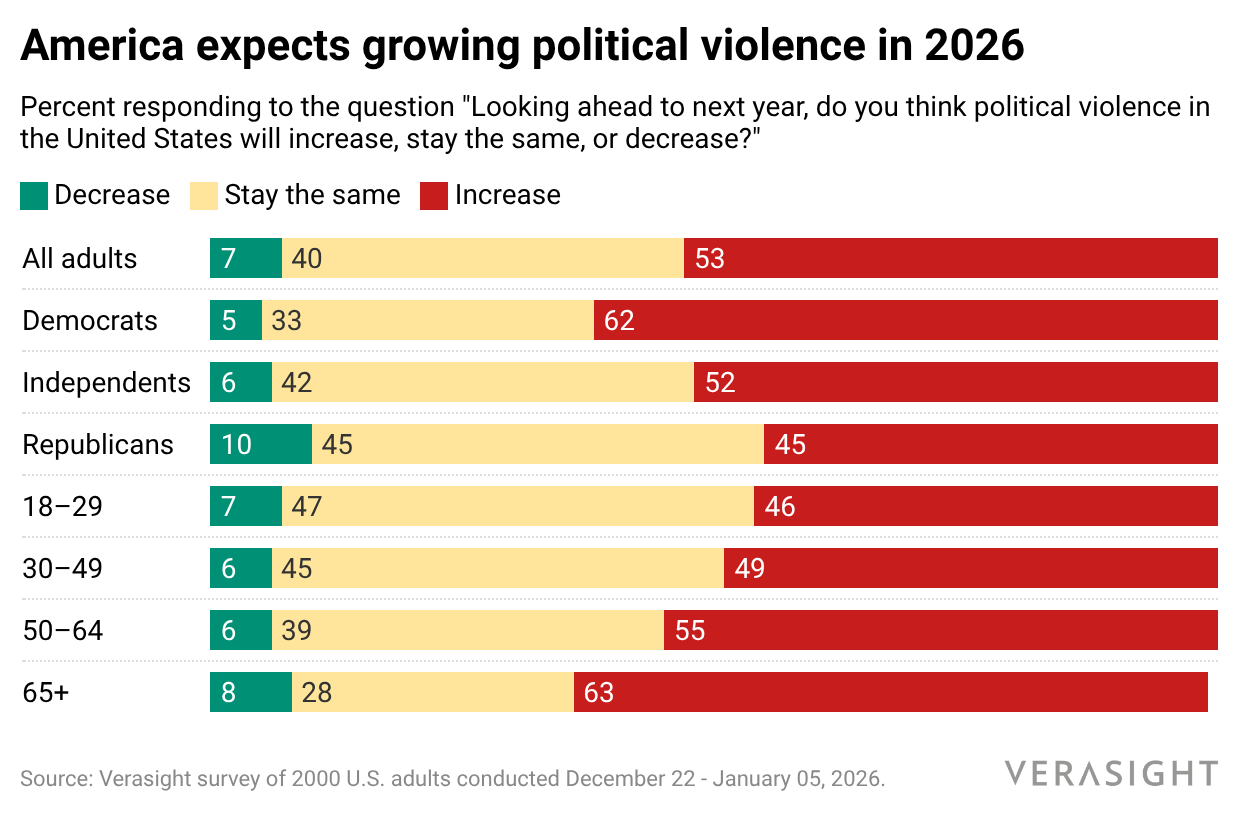
The party divide is notable too. Some 62% of Democrats expect partisan violence to increase, compared to 45% of Republicans. This gap might reflect different perceptions of who poses threats and how the political climate feels post-2024 election.
Women expressed slightly more concern than men about increasing violence. All in all, these findings paint a picture of a nation genuinely worried about where political discourse is heading.
Overall Outlook on 2026
So how do Americans feel about 2026 overall? They’re basically split down the middle. Forty percent expressed hopefulness (15% very hopeful, 25% somewhat hopeful), while 41% expressed worry (21% somewhat worried, 20% very worried). The remaining 20% felt neutral.
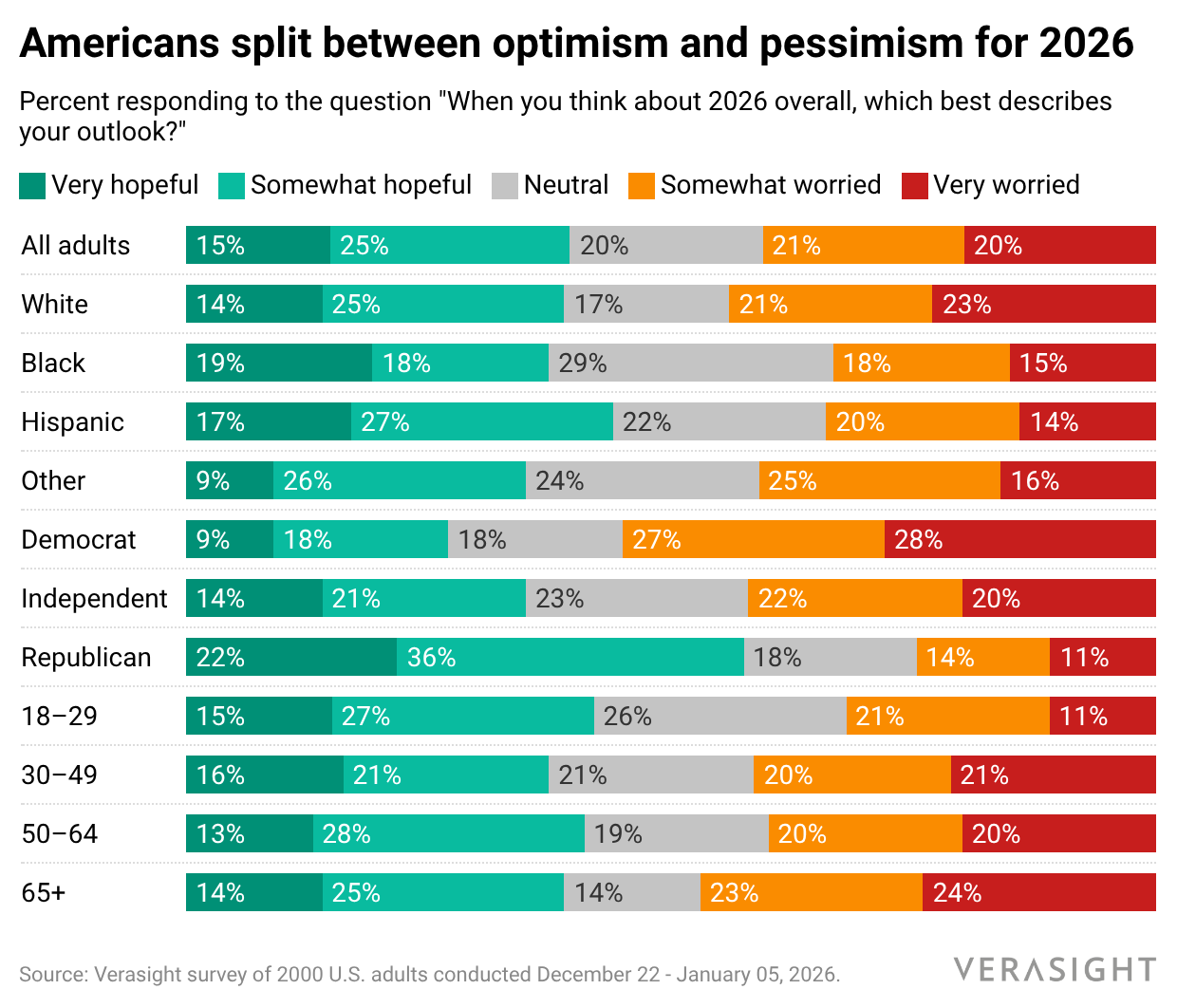
The partisan divide here is stark. Republicans are much more optimistic. 22% said they’re “very hopeful” compared to just 9% of Democrats. On the flip side, 28% of Democrats feel “very worried” versus only 11% of Republicans. It’s possible Republicans are more optimistic because their party is in charge of the government, similar to the dynamic we point out above where partisans are more optimistic on the economy when their party is in charge.
Young people aged 18-29 were the most optimistic overall, with 42% expressing some level of hope and just 32% feeling worried. Those 65 and older showed the opposite pattern, with only 39% hopeful versus 47% worried. The neutral camp stayed pretty consistent across ages, hovering around 20-26%.
In 2026, Americans are anxious, but that does not mean they are pessimistic. While they are bearish on the possibility of reduced prices and a resolution to various foreign conflicts, they remain optimistic about their own bank accounts and personal futures. While the national mood remains negative, Americans individually are filled with resilience and hope for the future.